Why Online Home Value Estimates Don't Tell the Full Story
Zillow says one number. Your neighbor sold for another. And your agent is telling you something different entirely. Here's why online estimates fall short — and what actually determines what your home is worth.
By Melissa Trinkl
If you've ever typed your address into Zillow or Realtor.com out of curiosity, you know the feeling — a number appears, and suddenly you have an opinion about what your home is worth. Sometimes that number feels right. Sometimes it feels wildly off. And if you've ever had a conversation with a local agent shortly after, you may have noticed the numbers don't always match.
That gap isn't a coincidence. It's a feature of how online estimates work — and understanding it can save you from a costly mistake when it's time to sell.
What Online Estimates Actually Are
Online home value tools — Zillow's Zestimate being the most well-known — are algorithm-driven estimates built on publicly available data. They pull from tax records, recent sales in your zip code, square footage, and basic property characteristics. They're fast, they're free, and they're a reasonable starting point for a general sense of the market.
But they're not an appraisal. They're not a comparative market analysis. And they are not what a buyer will pay for your home.
What They Can't See
Here's what an algorithm doesn't know about your home:
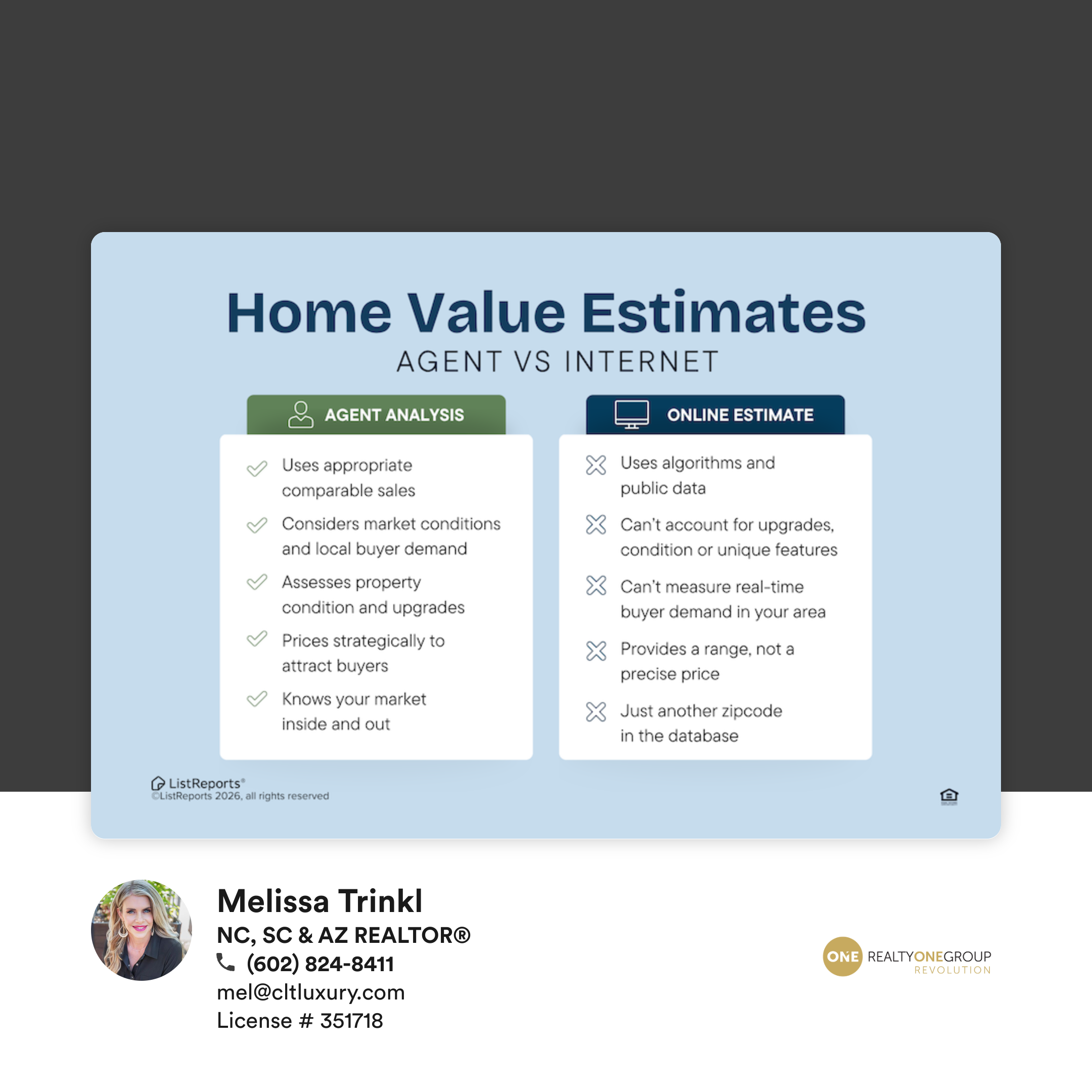
Your upgrades. The kitchen you renovated two years ago, the primary bath you gutted and rebuilt, the custom closet system, the new roof — none of that is in the public record. The algorithm is pricing a version of your home that may be years out of date.
Your condition. A well-maintained home and a deferred-maintenance home with identical square footage will sell for very different prices. An algorithm can't walk through your front door.
Your layout. A floor plan that flows beautifully commands a premium. An awkward layout that technically has the same bedroom and bathroom count does not. Algorithms don't experience floor plans.
Real-time buyer demand. The algorithm looks backward at closed sales. It doesn't know that three buyers are actively searching for exactly your home right now, or that a competing property just went under contract and removed your main competition from the market.
Your specific street, view, and lot. Within a single neighborhood, values can vary significantly based on factors that don't show up in a database — backing to a greenway, a corner lot, proximity to a busy road, a particularly private backyard.
What a Local Agent Actually Does
When I prepare a pricing analysis for a seller, I'm doing something fundamentally different from what an algorithm does.
I'm pulling the comparable sales that are actually comparable — not just the same zip code, but the same style, condition tier, and buyer profile. I'm adjusting for the specific differences between your home and those comps. I'm factoring in what's currently active and under contract, because that's your real competition. And I'm applying knowledge of buyer behavior in your specific neighborhood — what they're prioritizing, what they're willing to pay a premium for, and where they'll push back.
The result is a price that reflects what your home will actually sell for in today's market — not what an algorithm thinks it might be worth based on last year's data.
The Real Cost of Getting It Wrong
Overpricing based on an inflated online estimate is one of the most common — and most expensive — mistakes sellers make. A home that sits on the market because it's priced above what buyers will pay accumulates days on market, loses the momentum of a fresh listing, and often ends up selling for less than it would have with correct initial pricing.
Underpricing based on a low estimate leaves money on the table. In a market with genuine buyer demand, a well-priced home creates competition. Competition creates offers. Multiple offers create the conditions for a seller to achieve — and sometimes exceed — market value.
The Right Starting Point
Online estimates are fine for satisfying curiosity. They're not a substitute for a real conversation with a local agent who knows your neighborhood, has walked comparable properties, and can give you an honest, data-backed assessment of what your home is worth right now.
If you're thinking about selling — even if it's months away — that conversation is worth having early. The information you get will shape how you prepare your home, when you list, and how you price it. All of which affects your final number.
I offer complimentary home value consultations for Charlotte-area homeowners. If you'd like to know what your home is actually worth in today's market, I'd be glad to take a look.
Melissa Trinkl is a licensed REALTOR® and Pricing Strategy Advisor (PSA) serving Charlotte, NC and the surrounding region with Realty ONE Group Revolution.